Sainsbury’s - Redesigning the Argos, Habitat & Tu Delivery Experience
Q4 2020
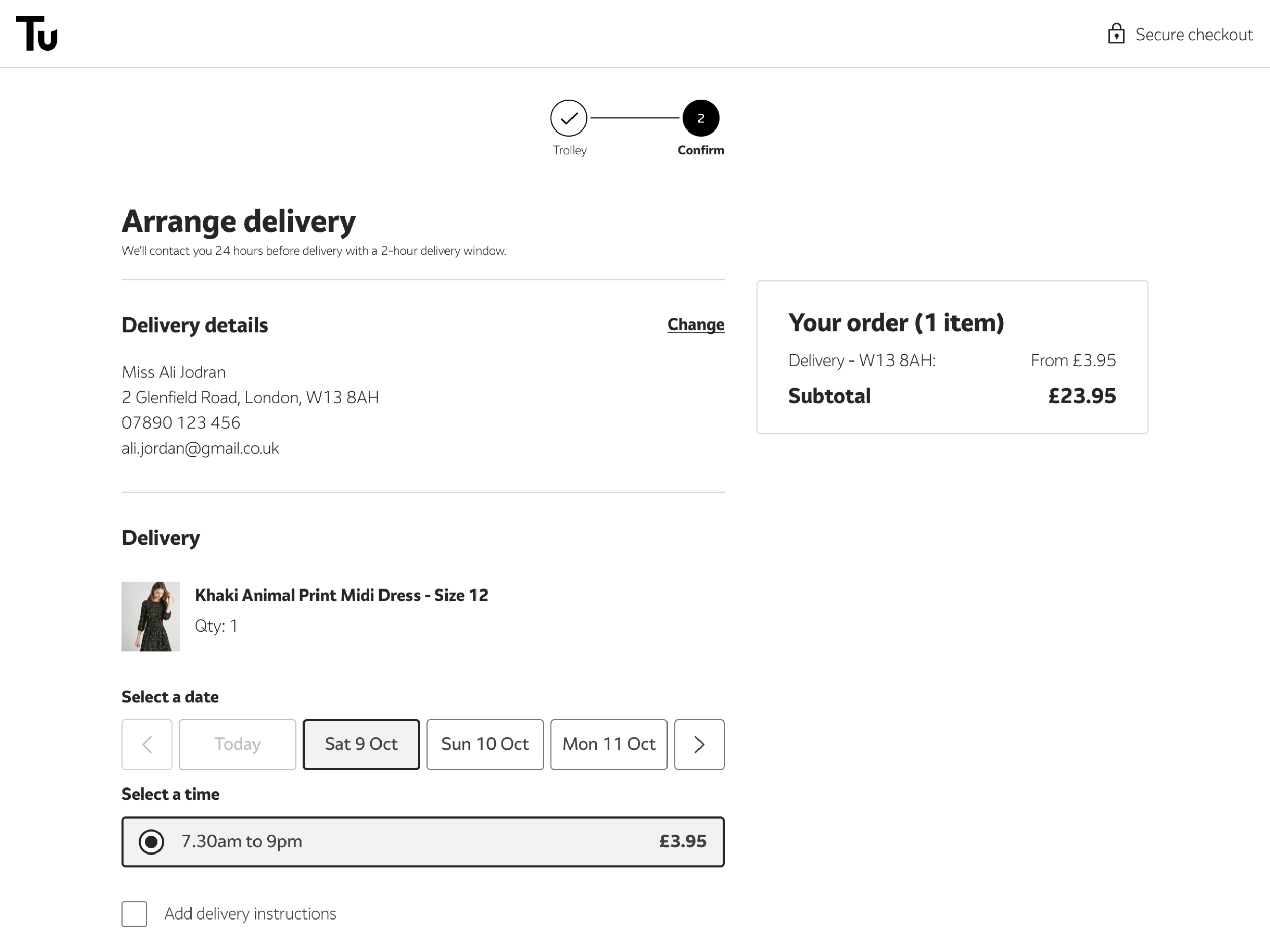
Argos serves over 430 million site visits annually across three brands - Argos, Habitat, and Tu. Each brand has fundamentally different delivery needs: Tu sells clothing with next-day expectations, Habitat sells large furniture requiring two-person delivery and installation windows, and Argos sells everything from digital downloads to garden furniture. Before this project, all three brands shared a delivery experience that had been designed for none of them particularly well.
The project ran for three months. The goal was to redesign the delivery experience end-to-end - from basket through to post-order confirmation - in a way that worked across every product category and every brand, while addressing the specific failures that were driving abandonment and customer service contacts.
The Problem
The existing delivery experience had accumulated several distinct failure modes:
Stock availability changed between the basket and delivery pages - customers selected items, progressed to checkout, and discovered at the delivery step that availability had changed. There was no graceful handling of this; the experience simply broke.
Delivery options were confusing, particularly for orders containing multiple items across different categories. A customer buying a Tu shirt and a Habitat sofa in the same basket faced a delivery selection process that didn't clearly communicate that these items would arrive separately, on different timelines, via different carriers.
Page timeouts during checkout caused customers to lose their progress entirely, with no recovery path.
Split deliveries were poorly communicated - customers didn't understand why their order was arriving in multiple shipments, creating customer service contacts and eroded trust.
The inability to select different delivery slots for different items in a single order was a fundamental gap, particularly for large Habitat items that required scheduling a specific time window.
Customer Service feedback from nearly 400,000 customers told a consistent story: confusion, frustration, and abandonment at exactly the point where the purchase should have felt certain.
My Role
Lead Product Designer across the full project. I was responsible for the research programme, synthesis, design, and working with engineers and product managers across all three brands simultaneously.
Process
Discover
The research programme was extensive given the scale of the platform and the breadth of the problem.
I analysed 400 survey responses identifying the primary pain points: stock changes during checkout, error states with no recovery path, and split delivery confusion. I ran 12 card sort exercises to understand how customers mentally categorised delivery options - the results informed how we structured the delivery selection UI. I conducted a heuristic analysis of the existing experience against usability principles, and reviewed 12 competitor experiences including Amazon and John Lewis to benchmark against industry standards.
Heatmap and clickmap analysis from Hotjar revealed exactly where users were dropping off - primarily during delivery slot selection and at the point where split deliveries were first communicated. The data confirmed what the customer service feedback suggested: the existing experience was asking customers to make decisions without giving them the information they needed to make them.
I synthesised all of this into an affinity map, empathy map, personas, and journey map - not as process artefacts for their own sake, but as working documents that the cross-functional team used to align on what we were solving and why.


Define
Three core hypotheses emerged from the research:
Real-time stock visibility during the checkout journey would reduce the shock of discovering unavailability at the delivery step - if customers knew earlier, they could make adjustments before investing further in the checkout flow.
Clearer communication about split deliveries - specifically why they were happening, what each shipment contained, and when each would arrive - would reduce both abandonment and customer service contacts.
A more flexible delivery slot selection system, allowing customers to choose different slots for different items in a single order, would address the single most-requested missing feature in the survey data.

Develop
The design challenge was unusually complex because the same UI had to handle fundamentally different delivery scenarios: a digital download with instant delivery, a Tu t-shirt with next-day courier delivery, a small Argos item available for same-day collection or standard delivery, and a Habitat sofa requiring a two-person delivery team and a scheduled time window. These aren't variations of the same problem - they're different problems that had to be solved within a single coherent system.
I produced multiple UI explorations for the delivery selection step, focusing on how to surface the right information for each delivery type without overwhelming customers who were buying a single simple item. The principle throughout was progressive disclosure - show customers what they need for their specific order, not every possible delivery scenario.
I conducted 20 moderated usability tests, iterating on prototypes between sessions. The testing revealed two consistent issues that weren't apparent from the analytics: customers didn't understand why split deliveries were necessary even when we explained it, and the terminology we were using for delivery types - "nominated day," "tracked," "two-man" - meant different things to different customers. Both required copy changes as much as structural design changes.
Deliver
The rollout was phased deliberately, not as a hedge but as a design decision. Shipping to Tu and Tu-through-Argos clothing first gave us a controlled environment to validate the core delivery selection model before introducing the complexity of Habitat large-item deliveries. Each phase informed the next.
Phase 1: Tu clothing delivery through Argos - validating the core model
Phase 2: Argos digital downloads, pre-orders, and small items, plus Habitat small items - extending the system to more product types
Phase 3: Large-item deliveries for Habitat and Argos - the most complex scenario, tackled last with the most learnings behind us
Alongside the delivery experience itself, the project included updates to the basket, checkout, post-order confirmation pages, and email communications - the full post-purchase journey, not just the delivery selection step.
Post-launch, I reviewed lagging data from site analytics and customer service feedback from nearly 400,000 customers to identify areas for ongoing optimisation.

Outcome
The redesigned delivery experience is live on Argos today. The full rollout completed in phases - some of which landed after I moved to my next role, which is a normal reality of enterprise shipping timelines on a platform this complex.
The research validated the core design decisions before launch: 20 moderated usability tests confirmed that the redesigned experience addressed the primary confusion points identified in discovery. The phased rollout approach meant we had real-world signal from each phase before committing to the next - a more reliable validation than a single large launch would have provided.
The specific commercial metrics from post-launch analytics are not included here - they're commercially sensitive and I left the team before full post-launch data was available. What I can say is that the customer service feedback that had informed the problem definition - nearly 400,000 contacts worth of consistent signals about split delivery confusion and stock availability surprises - was the measure we were most focused on moving.
Key learnings
Designing for a single system across fundamentally different product categories requires accepting that the system will be more complex than any single use case would suggest. The temptation is to design for the most common scenario and treat edge cases as exceptions. At Argos's scale, the edge cases are millions of customers.
Delivery copy is underrated as a design problem. The structural changes we made mattered, but the terminology changes - replacing industry jargon with language customers actually used - had an impact that was disproportionate to the effort required.
The phased rollout created a feedback loop that a single launch couldn't have. Each phase gave us data that made the next phase better. This is obvious in principle but requires genuine organisational alignment to execute - shipping something deliberately incomplete is uncomfortable for most teams.