Argos - Recovering Lost Sales at Checkout
Q4 2020 – Q2 2021
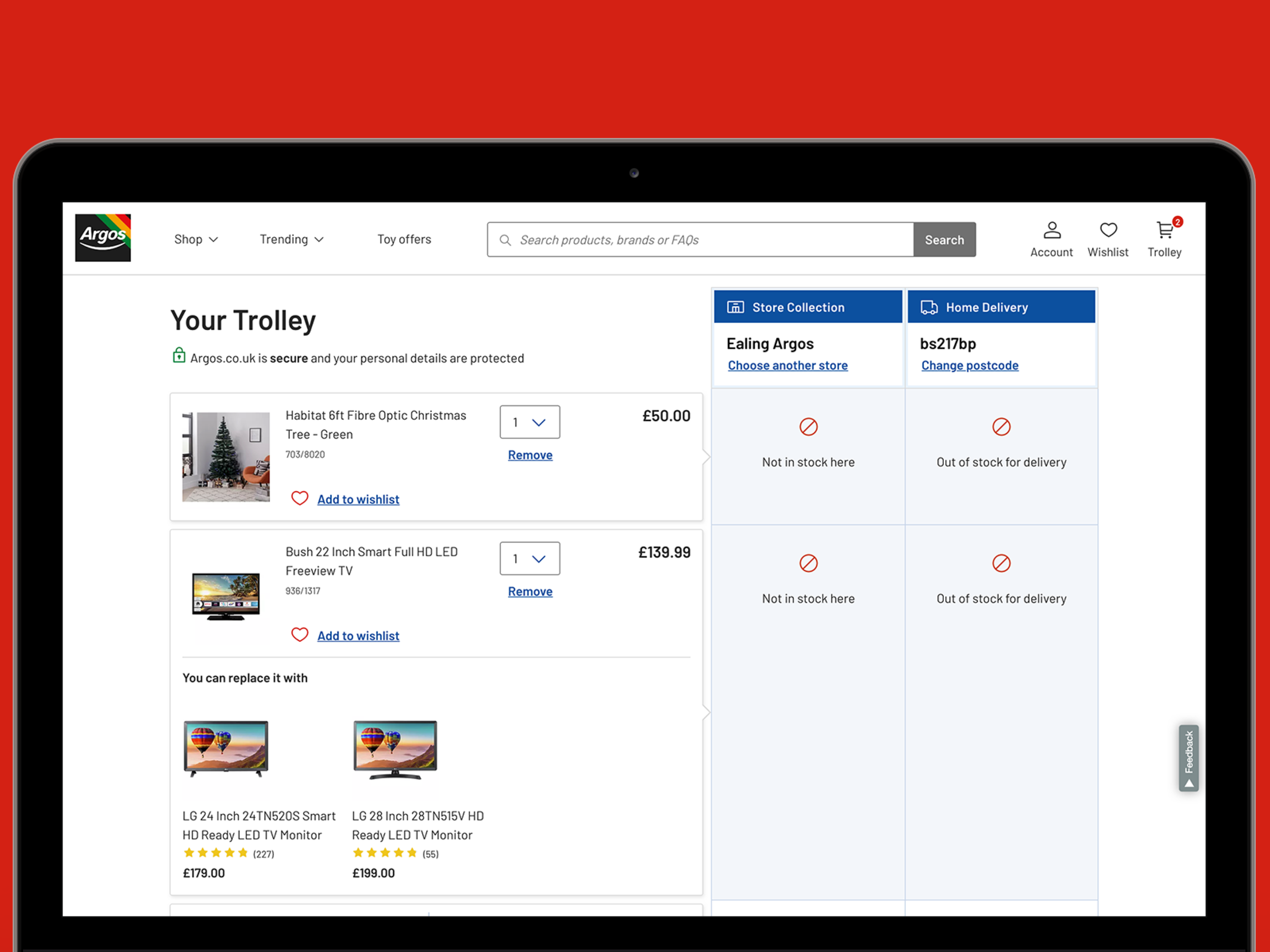
Argos serves over 430 million site visits annually. During 2020 and into 2021, 25% of trolley visits contained at least one out-of-stock product - a problem amplified by pandemic-driven supply chain disruption, the Suez Canal blockage, and surging demand for specific categories. Customers were building trolleys, reaching checkout, discovering items unavailable, and leaving. The business was losing a significant volume of transactions at the final step of the funnel.
The goal was to reduce that abandonment by surfacing relevant alternative product recommendations directly in the trolley - giving customers a path forward rather than a dead end.

The Problem
Out-of-stock disappointment is a specific kind of frustration. The customer has already committed - they've found the product, decided on it, added it to their trolley. Discovering it's unavailable at checkout feels like a betrayal of that decision. Generic upsell recommendations in that moment feel dismissive. To work, a recommendation has to feel like a genuine substitute, not an attempt to sell them something different.
This created a nuanced design challenge: the recommendation had to be relevant enough to feel like a real alternative, presented at exactly the right moment, without feeling pushy or opportunistic.
There was also a hard technical constraint. We couldn't modify the existing recommendation API - a system built by a single engineer, pre-AI explosion, that powered recommendations across the platform. Working within it required understanding exactly what it could and couldn't do. The PS5 being out of stock was a good example of the constraint in practice: we didn't want to show a PS4 as an alternative. The system also needed to verify that recommended items were actually in stock before surfacing them - recommending another unavailable product would make the experience worse, not better.
My Role
Lead Product Designer across the full project lifecycle - research, design, prototyping, and testing. I collaborated with two Product Managers, the Engineering team, recommendation engine experts, and stakeholders from the availability department.
Process
Discover
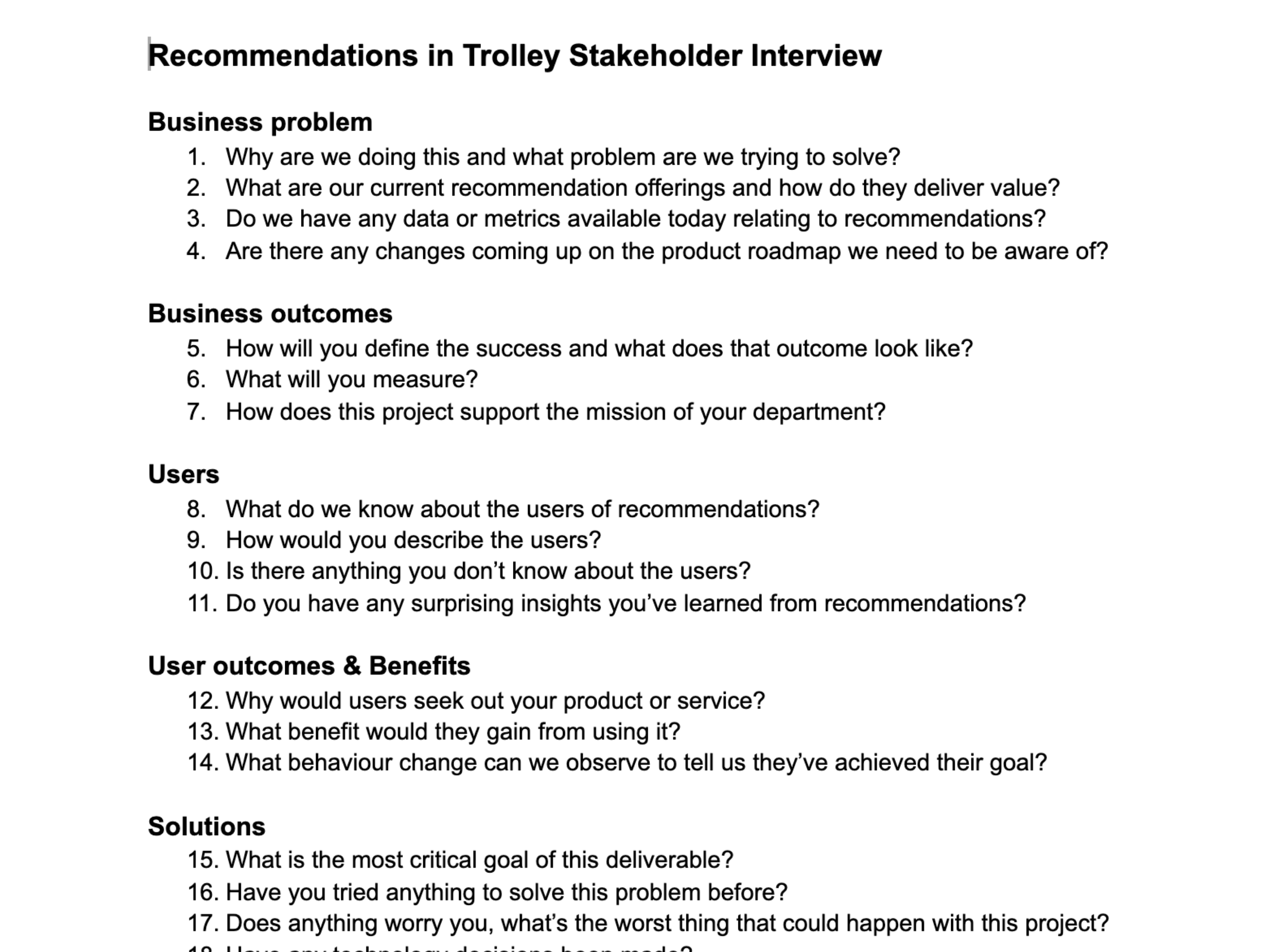
I began with stakeholder interviews across product, engineering, and the availability team to map how the existing recommendation system worked and where its boundaries were. Understanding the API constraints early was critical - it determined what solutions were even possible before we invested time designing them.
From there I ran usability testing on the existing OOS experience, conducted competitor analysis across major e-commerce platforms, and synthesised customer feedback from Foresee surveys and user interviews.
One practical challenge: there were limited existing design assets for the trolley page. I recreated the entire trolley flow for both desktop and mobile from scratch to enable prototyping and testing - work that also became a useful asset for future projects.

Define
Research synthesis identified several clear customer needs beyond the obvious desire for the out-of-stock item:
Many customers wanted the same product available at a different store for collection, even if it meant travelling
Pre-order capability was a strong preference - customers wanted the option to wait rather than be forced to choose immediately
Recommendations were acceptable but only if they felt genuinely equivalent - anything that felt like an upsell eroded trust rather than recovering the sale
We also developed a more nuanced understanding of how different customers respond to recommendations. Some were open and trusting. Others were sceptical but persuadable if the relevance was clear. A small group had been burned by bad recommendations before and were unlikely to engage regardless. These differences shaped how we presented alternatives - transparent reasoning about why a product was being recommended proved consistently more effective than presenting recommendations without context.
Three hypotheses emerged to guide the design direction:
Proximity matters - recommendations for nearby in-store stock could reduce abandonment for collection customers
Price sensitivity is high - customers were significantly less likely to accept recommendations priced above the original item
Category familiarity affects acceptance - customers were more open to recommendations for low-investment items like batteries than for high-consideration purchases like electronics


Develop
We produced multiple design directions for the trolley page, focusing on how to present alternatives without disrupting the checkout flow. Three approaches were explored and tested:
In-line recommendations displayed directly adjacent to the OOS product, keeping the recommendation in context without requiring navigation. A quick-view side drawer allowing customers to compare the alternative in detail - reviews, pricing, specifications - before committing to a swap. One-click replacement enabling customers to substitute the OOS item directly from the trolley without leaving the page.
We tested these directions through 13 rounds of usability testing - 84 talk-out-loud studies and surveys with over 350 participants. Each round surfaced specific friction points that we iterated on before the next. The volume of testing reflects the scale of the problem: at Argos's traffic levels, even small usability improvements translate into significant recovered revenue, and small mistakes at that scale are equally costly.
Key findings from testing shaped the final solution: customers needed to understand why a recommendation was being made, not just what it was. Transparency about relevance - "similar product, same category, currently in stock" - consistently outperformed recommendations presented without explanation.


Deliver
The final solution displayed in-stock recommendations directly inline with OOS products in the trolley. A side drawer allowed customers to explore alternatives in detail, and one-click replacement let them swap without navigating away. The design was fully responsive across desktop and mobile, built using existing design system components to minimise engineering complexity.
The solution was implemented via a series of JIRA tickets, followed by QA and A/B testing with 50% of customers over 25 days.
Outcome
The A/B test ran across 50% of customers for 25 days:
0.5% increase in conversion for customers shown in-stock recommendations
0.2% increase in revenue per visit
0.2% increase in units per order
0.9% decrease in exit rate
At Argos's scale - over 430 million annual site visits - a 0.5% conversion improvement represents a significant volume of recovered transactions. The solution was subsequently rolled out to 100% of Argos customers and was being extended to Habitat.
These are small percentages. They are also real ones, measured over 25 days against a 50% control group on one of the UK's highest-traffic retail platforms. At this scale, precision matters more than headline numbers.